

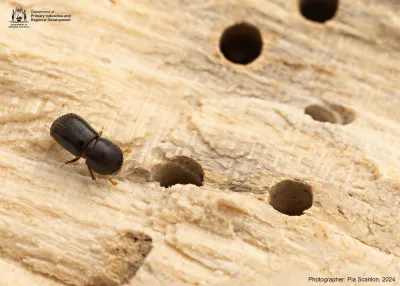
International trade poses a growing threat to global biosecurity, with bark- and wood-boring beetles representing a major concern for forest health. Non-native species are frequently introduced at points of entry, where populations can establish in the surrounding landscape. To improve early detection, generic surveillance programs use traps in these high-risk areas, collecting a broad spectrum of species. These traps also capture native beetles, providing insights into the potential species pool that could become exotic elsewhere. However, implementing effective landscape-wide surveillance within reasonable resource limits remains challenging. In this study, the authors used trapping data of Cerambycidae and Scolytinae from 11 high-risk areas across Europe and North America to develop practical recommendations for generic surveillance at multiple spatial scales. Specifically, they attempted to address two key questions: (1) how to maximize the single-trap efficacy depending on the trap surroundings; and (2) how many traps should be used in a landscape-wide sampling depending on landscape composition.
Nardi, Davide, Davide Rassati, Andrea Battisti, Manuela Branco, Claudine Courtin, Massimo Faccoli, Nina Feddern, et al. 2026. “Integrating Landscape Ecology into Generic Surveillance Plans for Bark- and Wood-Boring Beetles.” Ecological Applications36(2): e70194.
References to publications are provided as an information service only and do not necessarily constitute endorsement.